


Art Deco—defined by geometric shapes, abstract design, and lavish color—was the visual hallmark of luxury, glamour, and industrial progression. A product of innovative new machinery, economic growth, and social freedoms, the style was first introduced in France before World War I. However, it wasn’t until the 1920s, after the war, that it began to gain international traction. Antique and traditional techniques were revitalized as artists, designers, and architects applied the style across a broad range of visual fields, from opulent structures and interiors to fashionable handheld objects.
The Capstick-Dale collection illustrates forward-thinking artistry and mastery of materials on a small scale. From Jean Dunand’s fashionable eggshell technique to the exploration of lacquer techniques and engine-turned ornamentation, the objects in this auction are exquisitely detailed masterpieces of innovation and beauty.
Eggshell
Jean Dunand introduced the eggshell technique, a method used to achieve a white color when working with urushi, a Japanese varnish that has a brownish tint. Crushed eggshells are applied to the outer layer of the lacquered surface, with convex areas appearing whiter and concave areas appearing darker due to the eggshell's texture. The eggshell creates a varied color pattern and the surface is then cured to make the eggshell adhere before it is polished, and finished with a final layer of varnish. Dunand used this technique to create geometric designs, decorating various objects from cigarette cases to screens. The technique became very fashionable and was adopted by other designers and craftsmen.

Enamel
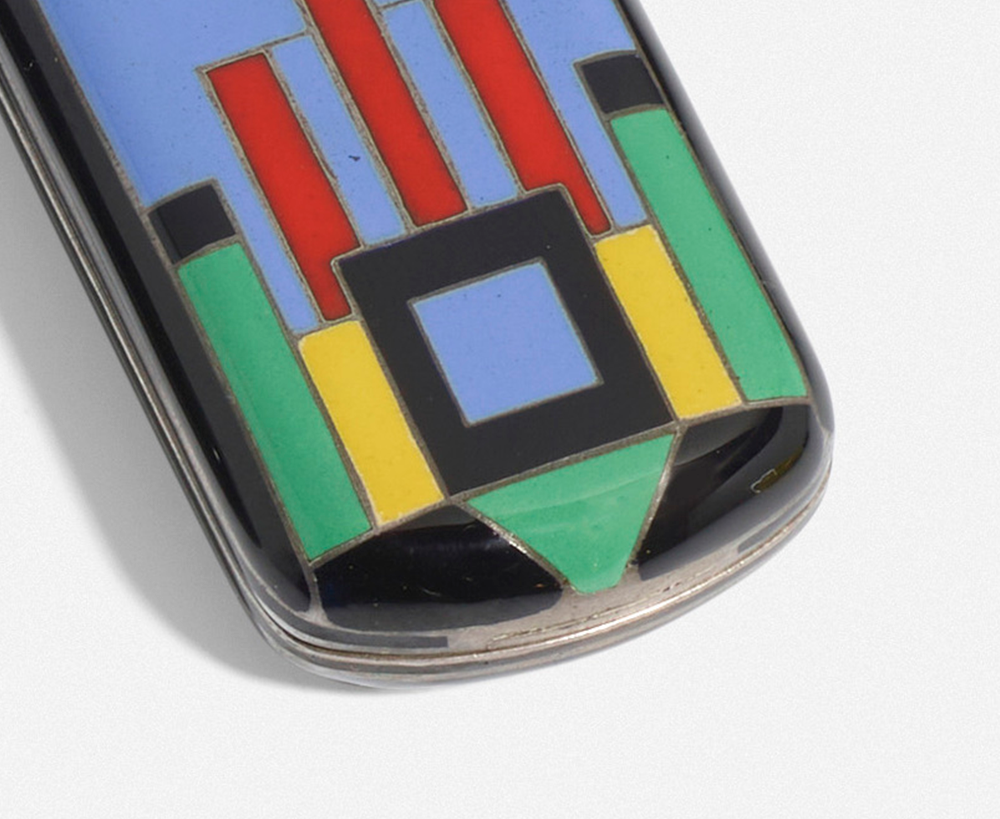
Enamel is created from a powder of silica, feldspar, borax, quartz, lead, and various color oxides, applied to metal and fired at high temperatures to form a hard, scratch-resistant, and water-repellent finish. Each color in the enamel has a different melting point, allowing multiple colors to be layered without melting the previous ones. Historically, enamel was used for portraits, miniatures, jewelry, and snuffboxes, gaining popularity in Europe during the 18th and 19th centuries. The early 20th century saw a resurgence in enamel use, particularly in Art Deco designs, as innovations allowed for mass production.
Lacquer
Lacquer is a naturally occurring polymer found in the bark of trees native to Japan, China, Vietnam and Taiwan. Raw sap from these trees is filtered and mixed with color pigments to create a varnish that is applied in layers to the surface of an object. This ancient technique was believed to have been discovered in China during the Shang dynasty (c. 1600-1046 BC). It was brought to Europe in the 16th and 17th centuries where it was widely admired and imitated. The advent of artificial polymers aided in the ease of production and during the early 20th century, designers used traditional lacquer technique to create bold, abstract designs.

Laque Arrachée
This variation on the lacquer technique involves lifting a layer of lacquer with a wood spatula and reapplying it to another lacquered surface producing a mottled effect. The layer can also be embellished with gold leaf, powders, or metal shavings before a final coat of varnish is applied to the surface.

Engine-Turned Finishes
Engine-turned finishes are a decorative technique that involves creating intricate, repetitive patterns on the surface of materials, often metal, using a specialized lathe. An adaptation of the 19th-century technique called guilloché, the process involves mounting the material on an engine-turning lathe, which has a series of geared wheels and rosettes that guide the cutting tool to create precise, repetitive designs. By adjusting the settings of the lathe, artisans can produce a wide variety of patterns, including spirals, waves, and interlacing lines. These patterns not only enhance the aesthetic appeal of an object but also increase its tactile quality.


It is in the realm of collectible objects that Art Deco has proved supreme. —Victor Arwas

Like priceless gems or tantalizing candies, the Art Deco treasures of the world-renowned Capstick-Dale Collection are small, colorful, and precious—portable emissaries of glamour, optimism, and exquisite craftsmanship arriving to the present from an era past. Encyclopedic in scope, this vast collection spans lighters and cigarette cases, minaudières, compacts, jewelry, and other personal accoutrements, together comprising a heralded and historically important group of objects sourced from around the globe and put together over the course of a lifetime. Documented in the Thames & Hudson volume Art Deco Collectibles and with examples from Jean Dunand, Raymond Templier, Gerard Sandoz, and Paul Brandt, among others, these works offer a truly illuminating glimpse of the Art Deco ethos and lifestyle. And while they are certainly a distinct product of a specific historical moment, they also speak to the timeless and universal allure of beautiful, small things to hold in one’s hand—or slyly retrieve from one’s pocket or purse.

Spanning from 1920 to the conclusion of World War II, the Art Deco era encapsulated a range of social shifts that, significantly, included an unprecedented marriage of design and manufacture. Resulting in what Jared Goss dubbed “the democratization of design,” this newly cemented partnership meant, as noted in Art Deco Collectibles, that “From the 1920s [on,] beautifully designed and well-made objects became widely available for the first time.” Marking a break from the ornate, flowery style of Art Nouveau, Art Deco aesthetics embraced linear geometries and influences that included Cubism, the Vienna Secession, Fauvism, and historic styles from China, Japan, India, Persia, and Egypt, as well as new materials including chrome, stainless steel, and plastic. With expert artisanry and manufacturing techniques to bring it all together, Art Deco objects embody the anticipation of a future whose doors had been flung wide open technologically and culturally.
With expert artisanry and manufacturing techniques to bring it all together, Art Deco objects embody the anticipation of a future whose doors had been flung wide open technologically and culturally.
While the Art Deco period ended when WWII shifted the attention of both consumers and manufacturers, the appreciation for the era’s material culture—particularly personal effects—has remained fervent, in no small part because of the undeniable and lasting quality of fabrication. When Rodney Capstick-Dale began to collect such items in the late 1960s, his passion was shared by figures including Yves Saint Laurent, Karl Lagerfeld, and Andy Warhol. From highly rare objects, including two Raymond Templier cigarette cases and a German Expressionist-influenced Cigarette case and lighter by Gerard Sandoz, to compacts, smoking accessories, and perfume packaging from unknown makers, each object in the Capstick-Dale Collection represents both an impassioned collector and an explosively exciting and generative moment in global history.
Cartier is one of the most recognizable names in luxury and their jewelry and timepieces are some of the most coveted in the entire world. Founded in 1847 by jewelry apprentice Louis-François Cartier, the company quickly became known for its high-quality workmanship and taste. Cartier became a supplier to the royal court of Napoleon III and by the end of the 19th century the company introduced branded watches. Louis-François’ grandsons, Louis, Pierre, and Jacques took over around the turn of the century and helped to establish the Cartier name worldwide.
The 20th century saw the rapid expansion and success of the firm. In 1904, they designed their Santos wristwatch for Brazilian aviator Alberto Santos-Dumont, a design so popular that it is still in production today. Several years later, Cartier signed a contract with the luxury watch and clock manufacturer Jaeger-LeCoultre. By this time, Cartier had offices in London, New York, and St. Petersburg and was becoming one of the most successful watch companies in the world. Their jewelry was also enormously successful, characterized by light and airy designs which stood in stark contrast to the more formal and highly decorative accessories of the period. They produced some of the best pieces the world had ever seen, including their famous tutti frutti necklaces and bracelets, made of multi-color gemstones, and a necklace for the Maharaja of Patiala consisting of nearly 3,000 diamonds. For a brief period in the early 20th century they were also owners of the infamous Hope Diamond, which was then sold to New York socialite Evelyn Walsh McLean.
Unlike many companies, Cartier managed to survive the Great Depression and continued to expand globally. Louis and Jacques died in 1942 and Pierre carried on leading the firm until his death in 1964. In 1972, the company was acquired by a consortium led by WW2 French Resistance hero, Robert Hocq, and they set about buying all of the branches of Cartier and forming a single entity, which it remains to this day. Cartier continues to be considered one of the premier jewelers and watchmakers, worn by celebrities, world leaders, and the wealthy elite, and operating 200 stores in 125 different countries.


